






The Logistics of Abundance: A Deep Analysis of Production Chains and Transport Dynamics in Pioneers of Pagonia
The genre of "Wuselfactor" city-builders has long been defined by the intricate dance of tiny citizens moving goods from point A to point B. In Pioneers of Pagonia, developed by the visionary Volker Wertich, this concept is elevated from a mere background mechanic to the very soul of the gameplay. Unlike titles that abstract resources into a global inventory, Pagonia demands a physical presence for every log, stone, and loaf of bread. This article explores the deep-seated mechanics of the game's logistics and production philosophy, examining how the physical manifestation of labor creates a living, breathing economy that transcends traditional simulation boundaries.
1. The Philosophy of Physicality: Why Every Unit Matters
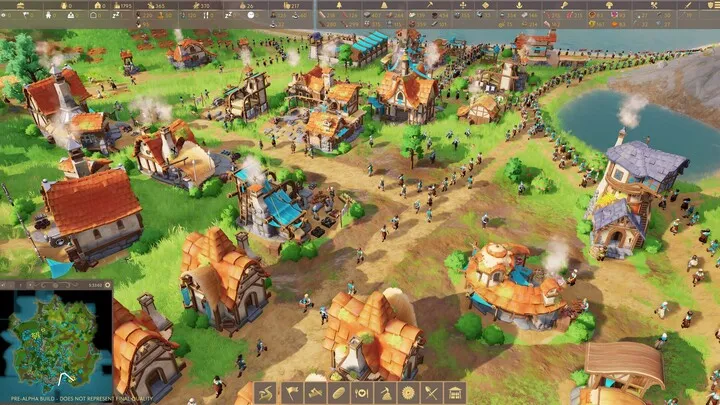
In Pioneers of Pagonia, the "Wuselfactor" is not just a visual gimmick; it is a fundamental constraint on efficiency. Every item in the game exists as a 3D entity that must be manually carried by a unit. This creates a direct correlation between the spatial layout of a village and its economic output. If a lumberjack is too far from a sawmill, the sawmill sits idle. This physical manifestation of supply chains means that players are not just managing numbers on a spreadsheet, but rather the flow of physical matter through a simulated space.
This commitment to physicality extends to the way workers interact with their environment. A carrier does not simply "teleport" a resource; they must navigate the terrain, respect the pathfinding logic, and wait for the hand-off animation to complete. This granularity ensures that the "heartbeat" of a Pagonian settlement is visible. By observing the flow of carriers on a main road, a player can diagnose bottlenecks without ever opening a menu, making the visual feedback loop the most important diagnostic tool in the game.
2. The Hierarchy of Roads: Structural Integrity of Transport
Roads are the circulatory system of Pagonia, and their placement dictates the metabolic rate of the colony. The game distinguishes between basic paths and stone roads, but the true depth lies in the intersection logic. As a settlement grows, the volume of traffic on central arteries can lead to "logistical gridlock." This occurs when too many carriers attempt to traverse the same node, leading to a breakdown in the "Just-in-Time" delivery system that the most advanced production chains require.
Designing for High Volume
- Arterial Bypass: Creating secondary roads that bypass the central warehouse allows essential construction materials to reach the frontier without getting stuck in the food distribution loop.
- Node Spacing: Placing buildings slightly back from main roads creates "parking zones" for carriers, preventing them from blocking the primary thoroughfare while waiting to drop off goods.
To master the logistics, one must view the map as a series of pressure zones. High-density industrial sectors require a web of interconnected paths rather than a single line. By diversifying the routes, the player ensures that the "carrier AI" can calculate the path of least resistance, maintaining a steady flow of copper ingots and wooden beams to the ever-expanding borders.
3. The Granularity of the Lumber Cycle: Wood as the Foundation
While wood is the most basic resource, its production chain in Pioneers of Pagonia is a masterclass in recursive logistics. It begins with the Forester, whose role is not merely to plant trees, but to manage the forest's density. A forest that is too thick prevents the Lumberjack from maneuvering efficiently, while one that is too thin leads to downtime. The interaction between the Forester and the Lumberjack creates a localized ecological balance that must be maintained to feed the Sawmills and Woodcutters.
The transformation of a log into a wooden beam or firewood is a transition from raw material to structural or energetic utility. In Pagonia, the "Wood Workshop" acts as a critical pivot point. Here, logs are turned into tools or weapons. Because these items are high-value and low-volume, the transport priority shifts. A single carrier bringing a finished sword to the Guardhouse is more valuable than a dozen carriers moving firewood to a tavern. Managing this priority through the placement of dedicated "Input Warehouses" is what separates a functional village from a prosperous one.
4. Geological Prospecting and the Ore Processing Pipeline
Mining in Pagonia is a multi-stage intellectual challenge. It starts with the Explorer, who must manually uncover hidden deposits. Unlike other games where resources are clearly highlighted, Pagonia requires the player to read the terrain. Once a vein is found, the logistical challenge of "Deep Extraction" begins. Mines are often located in mountainous, difficult-to-reach terrain, necessitating a complex system of switchback roads and relay stations to bring coal and iron down to the smelters in the valley.
The Metallurgy Chain
- Mining: Raw ore and coal extraction at the source.
- Smelting: High-energy processing requiring a constant influx of coal and ore.
- Blacksmithing: The conversion of ingots into tools, armor, or weapons.
- Distribution: The final transport to military or civilian hubs.
The Smelter is the "black hole" of the iron chain; it consumes resources at a rate that can easily bankrupt a poorly planned logistics network. Because the Smelter requires two different inputs (coal and ore) to produce one output (ingot), the road density leading to the Smelter must be twice that of the road leading away from it. This "input-output ratio" is a recurring theme in Pagonian engineering.
5. Agricultural Synergy: The Bread and Rations System
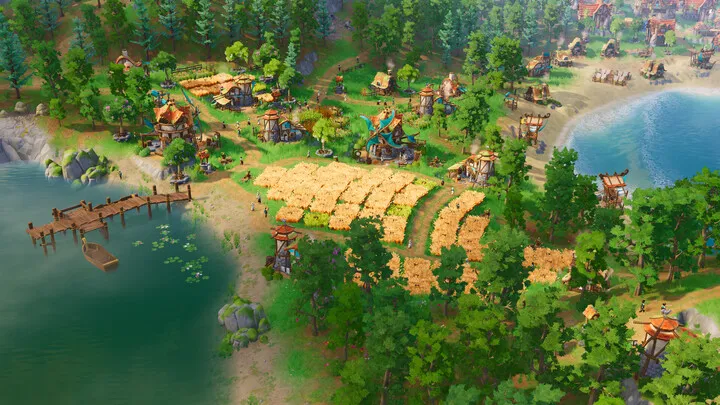
Food in Pioneers of Pagonia is not consumed for survival, but for "Work Motivation" and "Exploration." This distinction is vital. A hungry worker doesn't die; they simply stop being productive. The agricultural chain starts with the Farm, which produces wheat. However, wheat is useless until it is processed by the Windmill into flour, and then by the Bakery into bread. Each step in this process adds "Logistical Friction," as the resource must be moved between three separate buildings.
To minimize this friction, advanced players create "Agri-Clusters." By placing the Farm, Windmill, and Bakery in a triangular formation with a shared well, the transport time is reduced to the absolute minimum. Furthermore, the Tavern acts as the final destination for these goods, converting bread and meat into "Provisions." Provisions are a unique resource that facilitates the expansion of the map. Without a steady stream of meat pies and bread, your explorers cannot venture into the fog, effectively halting the game's progression.
6. The Weaver’s Loom: Flax, Ropes, and Sailcloth
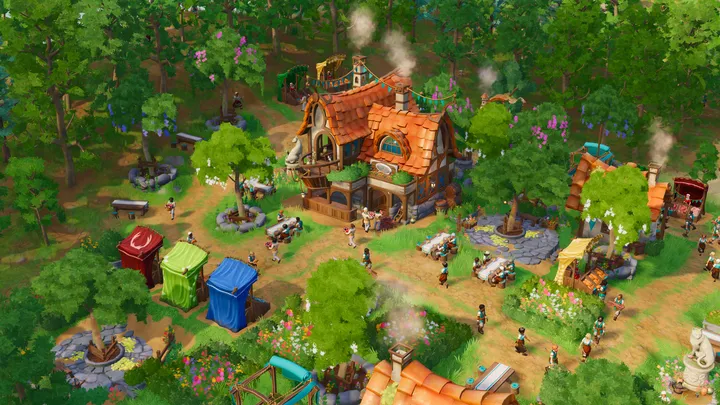
The textile industry represents the shift from "Survival Logistics" to "Expansion Logistics." Flax farms are the primary source of fiber, which is then processed at the Weaver into cloth or ropes. These materials are essential for advanced buildings and ship construction. The complexity here lies in the land requirement. Flax farms require vast, fertile plains, which often compete with wheat farms for space. The player must decide whether to prioritize "Food Security" or "Industrial Growth."
Textile Utility List
- Ropes: Required for cranes and heavy construction projects.
- Sailcloth: Necessary for the Shipyard to build transport vessels.
- Adventurer Gear: Enhances the survival rate of units exploring dangerous biomes.
The Weaver's hut is often a low-traffic area until a major project (like a ship) is initiated. This creates a "Spike Demand" in the logistics network. A sudden request for 50 ropes can paralyze a transport system that isn't prepared for the surge. The use of "Buffer Warehouses"—storing finished goods near the Shipyard ahead of time—is the only way to mitigate the impact of these industrial spikes.
7. Boundary Expansion and the Role of the Guardhouse
The borders of your territory are not static; they are pushed by the physical presence of Guards. This is a unique logistical element where "Security" is a delivered service. To expand, a Guardhouse must be supplied with weapons and shields. Once equipped, the Guards patrol the border, slowly claiming territory for Pagonia. This expansion is the primary driver of the mid-game, as it opens up new resource nodes and tactical positions.
However, expansion comes with a "Logistical Tax." The further your borders push out, the longer it takes for construction crews to reach the edge. A common failure state in Pioneers of Pagonia is "Over-Expansion," where the player claims so much land that the carriers spend all their time walking to the periphery, leaving the core economy to starve. Maintaining a "Compact Core" while utilizing "Frontier Outposts" is the strategic solution to the problem of distance.
8. The Warehouse Logic: Buffering against Supply Volatility
Warehouses in Pagonia are not just storage boxes; they are "Shock Absorbers" for the economy. Each warehouse can be configured to accept specific goods, allowing the player to create localized hubs. For instance, a warehouse near the Blacksmith should be set to "Accept Coal" and "Accept Iron Ingots." This creates a "Pull Factor" in the logistics AI, encouraging carriers to bring materials to the hub even when the Blacksmith doesn't immediately need them.
Warehouse Optimization Strategies
- Regional Specialization: Dedicate warehouses to specific industries (e.g., a "Construction Hub" for stone and wood).
- Overflow Management: Use warehouses to store excess food during high-yield seasons to prevent waste.
- Chain Linkage: Place warehouses at the halfway point of long-distance transport routes to allow carriers to "relay" goods, reducing individual fatigue.
Without warehouses, the economy operates on a "Pull" system only—meaning a building only requests a resource when it is empty. This leads to massive downtime. Warehouses transform this into a "Push-Pull" hybrid, where resources are constantly moved toward the areas where they are most likely to be needed, ensuring that the Smelter's fire never goes out.
9. The Alchemy of Construction: Materials and Masonry
Every building in Pagonia requires a specific combination of wooden beams and stones. As the game progresses, higher-tier buildings require "Cut Stone" from the Stonemason. This adds a layer of refinement to the most basic construction loop. The Stonemason acts as a bottleneck; if you are building five structures at once, the demand for cut stone will skyrocket, leaving your construction sites half-finished for ten minutes while the Mason slowly chips away.
The "Masonry Cycle" is often overlooked. Because stones are heavy, they are the slowest items to transport. Strategic placement of the Stonemason near a large quarry is essential, but it must also be accessible to the central warehouse. The interplay between the weight of the resource (Stone) and the refinement time (Masonry) creates a "logistical lag" that the player must anticipate. Planning your city's expansion ten minutes in advance is the only way to account for the slow movement of masonry.
10. Divine Intervention: The Impact of Altars and Monuments
In the late game, Pioneers of Pagonia introduces spiritual and monument-based objectives. These structures are the ultimate logistical test, requiring thousands of high-tier resources like gold ingots, marble, and ceremonial wine. Building a Great Altar is not a test of your wealth, but a test of your "Flow Capacity." Can your road network handle the transport of 200 gold bars without the food supply to the Tavern breaking down?
The Altar acts as a massive "Resource Sink." During its construction, every other industry in the village will slow down as the carriers are diverted to the monument site. This is the game's final exam. The player must temporarily shut down non-essential industries (like tool production) to free up the labor force. Successfully completing a monument is the physical proof that your logistics network is not just functional, but optimized to the point of "Abundance Logistics," where the village can support both survival and grandeur.
Conclusion
Pioneers of Pagonia is a symphony of moving parts, a game where the "Wuselfactor" is elevated to a sophisticated economic simulation. By forcing the player to respect the physical reality of resource transport, it creates a deeply satisfying loop of optimization and observation. From the humble lumberjack to the grand Altar of Pagonia, every unit and every road plays a vital role in the survival of the colony. Understanding that logistics is not a secondary concern, but the primary engine of growth, is the key to mastering the game. In Pagonia, the most beautiful sight is not the finished cathedral, but the thousands of tiny carriers moving in perfect, unhindered harmony to build it.