.webp)





Stray is often summarized as “the game where you play as a cat,” but this description overlooks its most deliberate structural choice: the player embodies a creature defined not by power, but by fragility. Unlike conventional third-person adventure protagonists who reshape environments through strength or tools, the cat in Stray survives through agility, curiosity, and avoidance. This constraint is not cosmetic. It forms the backbone of the game’s environmental storytelling.
This article examines how limited feline agency becomes a narrative instrument. By restricting combat capability, interaction scope, and scale perception, Stray forces players to read the world through vulnerability. The result is an experience where architecture, sound, and motion communicate more effectively than exposition.
1. The Opening Fall and the Establishment of Fragility
The early sequence, in which the cat becomes separated from its companions, immediately frames the experience around loss and smallness.
There is no heroic resilience, no empowerment tutorial. The fall into the walled city is abrupt and silent, emphasizing isolation rather than triumph.
This opening conditions players to interpret the world not as a battlefield, but as a maze. Survival becomes observational rather than confrontational.

2. Eye-Level Design and Environmental Scale
The camera remains low, close to the ground.
This fixed perspective reshapes architectural perception. Doorways loom. Furniture becomes terrain. Pipes become highways.
Micro-scale navigation
What would be decorative clutter in other games becomes essential traversal infrastructure.
By anchoring perspective to a cat’s height, the environment communicates through verticality and density.
3. Interaction Without Dominance
The cat cannot wield weapons or manipulate complex machinery independently.
Most interactions involve simple actions: jumping, scratching, carrying small objects, or triggering switches.
Minimalist agency
This constraint eliminates dominance as a narrative tool.
Instead of conquering space, the player negotiates it.
4. The Role of the Drone Companion
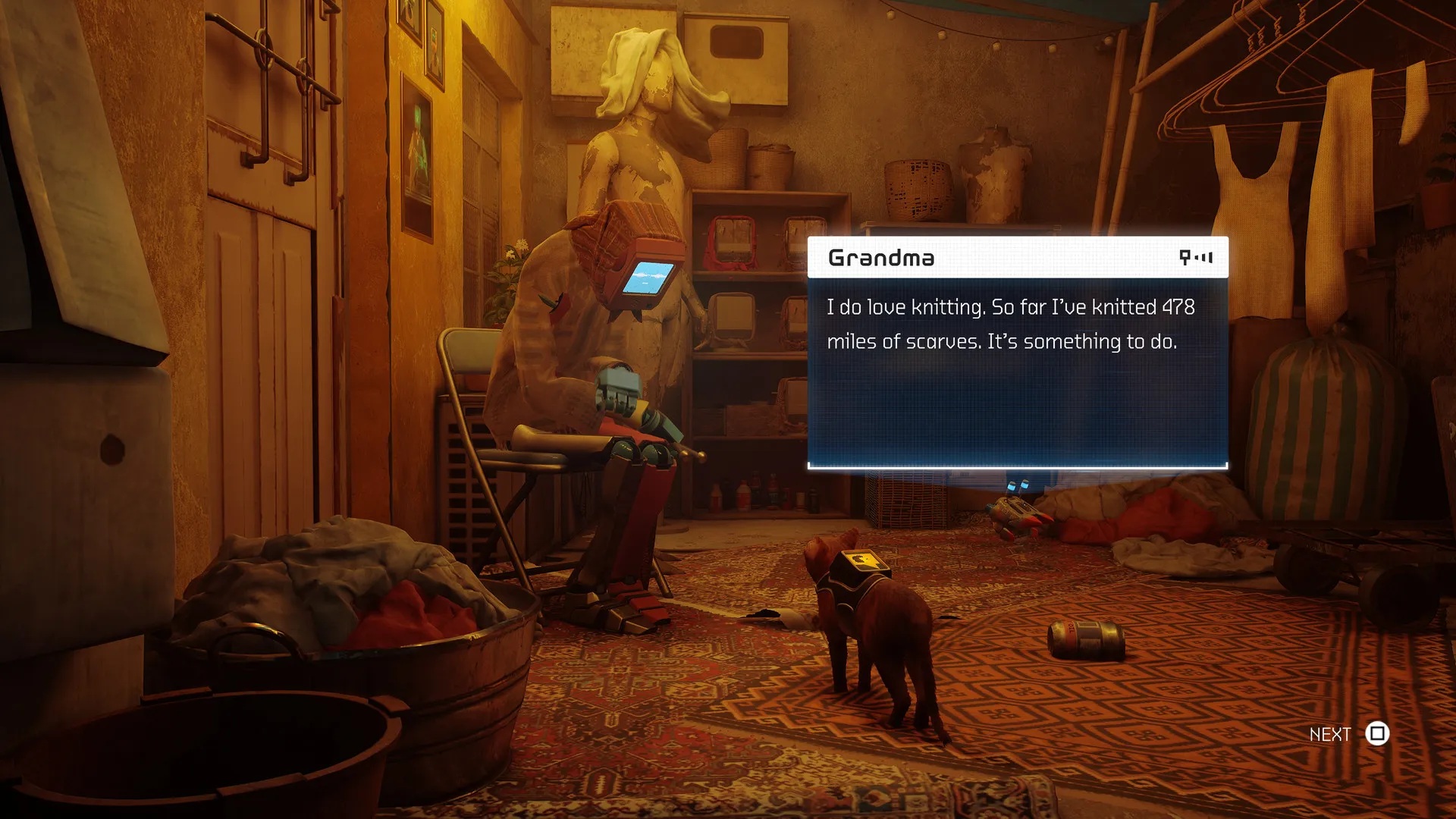
B-12 functions as a translator and technological intermediary.
The drone bridges the gap between animal limitation and narrative exposition.
Distributed agency
Agency is divided between instinct and intellect.
The cat moves; the drone interprets. Together they form a hybrid protagonist.
5. Hostility Through Overwhelm Rather Than Duel
Enemies in Stray are rarely designed for direct confrontation.
Zurks swarm rather than duel. Sentinels patrol with lethal precision.
Asymmetrical threat
Conflict is structured around escape and evasion.
The player survives not by overpowering threats but by outmaneuvering them.
6. Environmental Storytelling Through Ruin
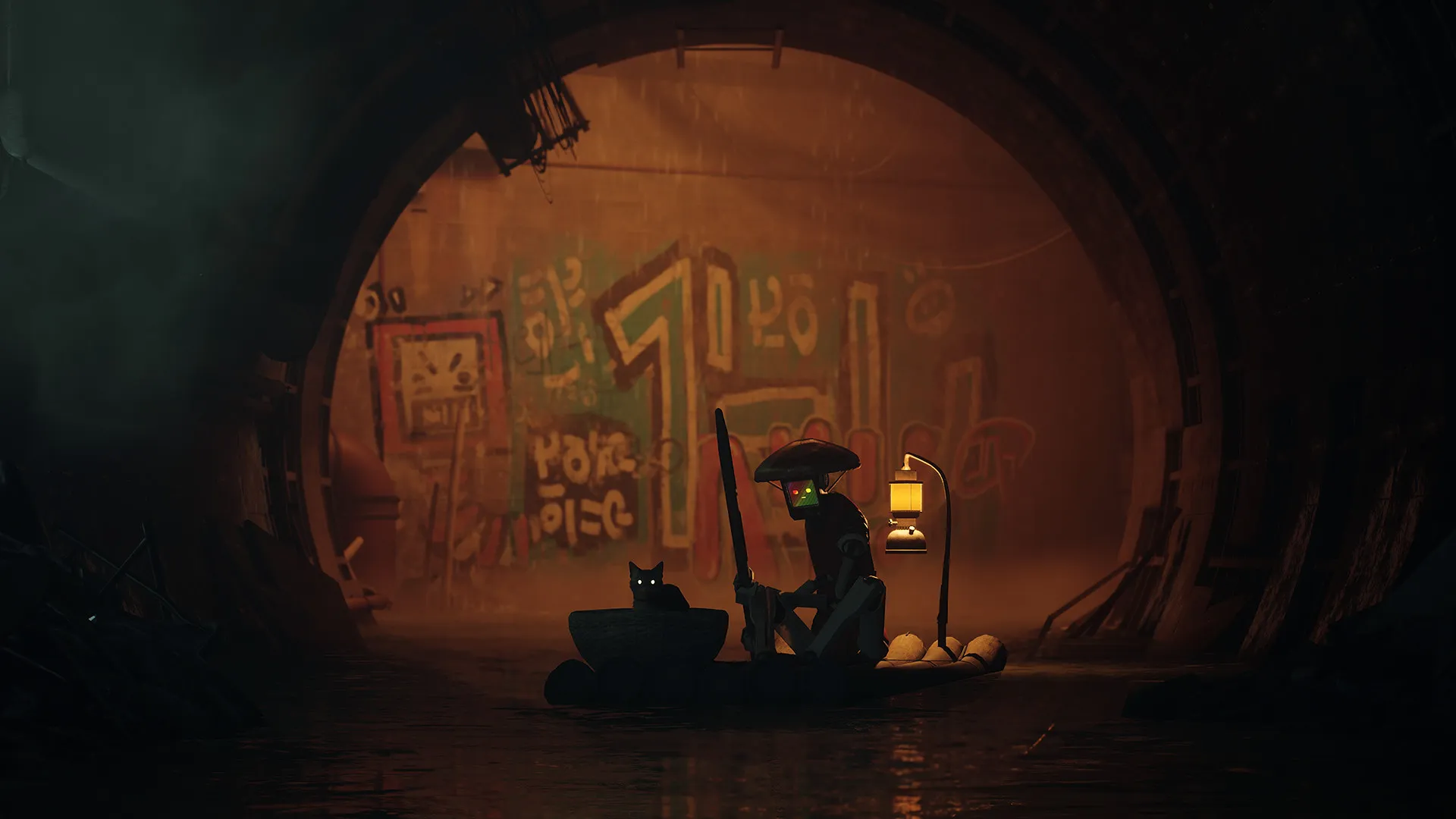
The walled city tells its story visually.
Neon signage flickers over decaying infrastructure. Abandoned apartments suggest past domestic life.
Silent archaeology
Players reconstruct history by observing spaces rather than reading exposition-heavy dialogue.
Smallness sharpens attention to detail.
7. Movement as Emotional Expression
Feline animations are precise and deliberate.
Stretching, curling up to sleep, or nudging objects add subtle emotional texture.
Embodied empathy
Physical behaviors humanize the protagonist without dialogue.
The absence of speech amplifies physical storytelling.
8. Sound Design and Spatial Awareness
Footsteps echo differently across surfaces.
Ambient hums, distant machinery, and subtle environmental cues shape spatial understanding.
Acoustic vulnerability
Audio signals danger and safety before visual confirmation.
The world feels alive because it is heard before it is fully seen.
9. Pacing Through Curiosity Instead of Urgency
Stray encourages slow exploration.
Optional interactions—knocking over paint cans, curling up beside robots—reinforce presence over progress.
Contemplative traversal
The rhythm of play mirrors feline curiosity rather than human urgency.
This pacing deepens immersion in environmental detail.
10. Why Vulnerability Defines the Experience
A more powerful protagonist would alter the game fundamentally.
Combat-heavy systems would shift focus from observation to domination.
Stray succeeds because it resists that shift. Smallness is not a gimmick; it is the structural principle guiding perception, movement, and narrative comprehension.
Conclusion
Stray demonstrates how limiting player power can intensify environmental storytelling. By placing players inside the body of a small, vulnerable creature, the game reframes architecture as terrain, hostility as overwhelm, and interaction as negotiation. Agency becomes precise rather than expansive. The world is not conquered; it is navigated carefully, read attentively, and survived thoughtfully.
Through this design philosophy, Stray proves that scale and fragility can be more narratively expressive than strength. In doing so, it offers a quiet but powerful reminder that perspective—literal and mechanical—defines how stories are experienced in interactive media.